
Gaia · AI tutor

Gaia asks before it answers.

Gaia is a multi-agent conversational tutor developed in L2BGreen. It guides learners through real business cases, gives hints first and reveals answers only once they have stretched their own thinking.

Try Gaia

One tutor, four agents

Gaia runs as an interaction engine. Each agent takes care of one pedagogical job.

  1. Present the case

    The case agent sets the scene: a real company, a real decision.

  2. Scaffold knowledge

    Hints and follow-up questions come before any answer.

  3. Support application

    Learners apply concepts to the case and to their own plans.

  4. Feedback on arguments

    Argumentation-aware feedback points out gaps in reasoning.

Built on

  • Case-based learning
  • Bloom's taxonomy
  • Socratic scaffolding
  • AI-supported feedback

What 25 students showed us

25undergraduate students
3weeks
3online cases
45+minutes per case on average
25+messages per week

Findings

  • Engagement stayed high, and student messages increased significantly from the first to the third case.
  • Students rated the usability and the learning materials positively.
  • Learners with less prior orientation toward green entrepreneurship talked longer with Gaia.

What we change next

  • Some found the text-only format tiring, so dialogues will become shorter and more focused.
  • Next step: multimodal interaction beyond text.

One of the most encouraging findings is that learners did not only complete the activities, but actively interacted with Gaia.

Stergios Tegos, enchatted
AIED 2026

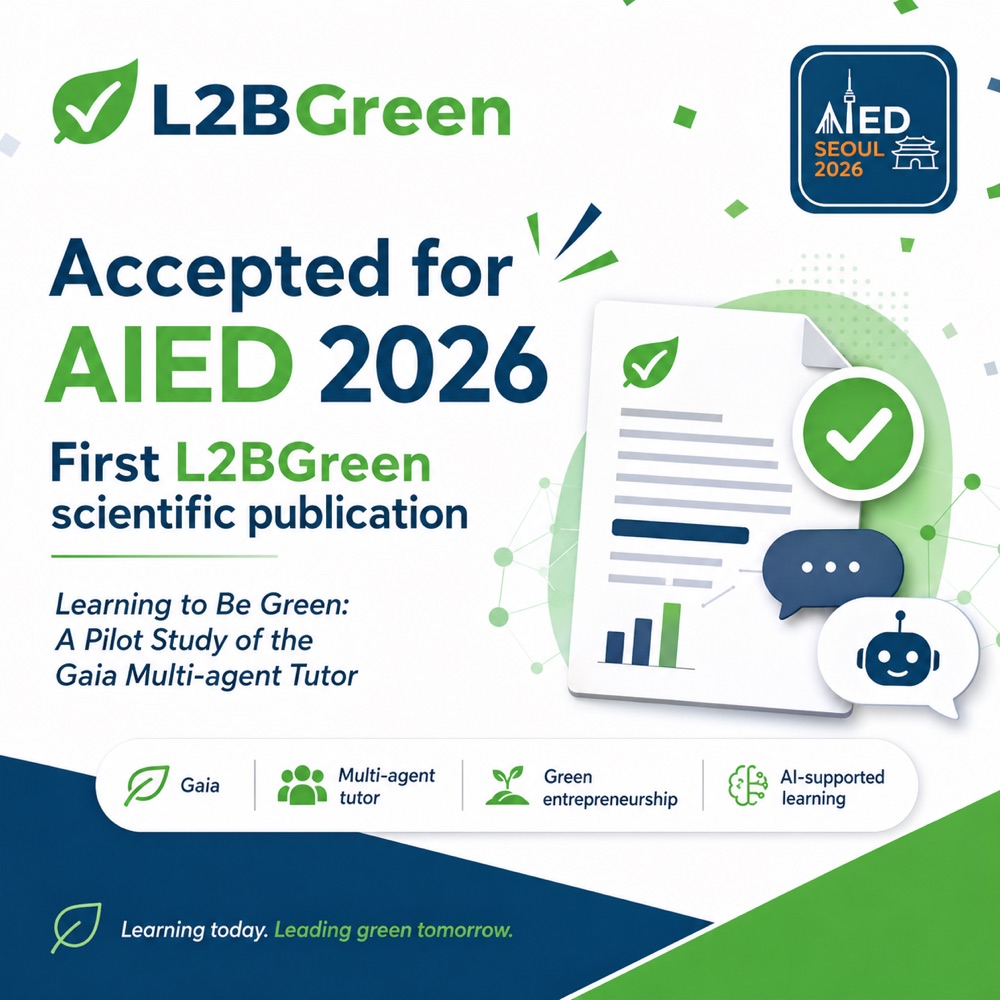
Learning to Be Green: A Pilot Study of the Gaia Multi-agent Tutor

Ahsen Çini, Pantelis M. Papadopoulos, Stergios Tegos, Apostolos Mavridis. Accepted at the International Conference on Artificial Intelligence in Education.

Read the announcement

Try Gaia now

The L2BGreen learning environment is open. Pick a case from the catalogue and work through it with Gaia, alone or with your class.

Start learning
Co-funded by the European Union

Funded by the European Union. Views and opinions expressed are however those of the author(s) only and do not necessarily reflect those of the European Union or the European Education and Culture Executive Agency (EACEA). Neither the European Union nor EACEA can be held responsible for them.